
How do you get the best out of Bag Sealers? What it can and cannot do.
Typical equipment for bag sealing and plastic sealing
Process
The material you wish to seal or close is placed between the "jaws." The sealing process starts and the material is welded together, cooled, and then — if the machine is capable — cut at the desired length, depending on the sealer type and feature.
Bag sealers work by heating the material using either constant or pulse heat during activation. The process is also called plastic welding; PE welders and bag closers can all be used for welding heat-weldable materials.
What to pack using a bag sealer
Everything — from magazines, newspapers, catalogues and books, to fruit, vegetables, postcards, Christmas ornaments, screws, fittings, liquid, powder, spices, candy, coffee, tea, rice, oatmeal, cream, bread, cakes, and more.
It is not recommended to seal materials that are toxic or cause discomfort if inhaled during evaporation. This should always be performed in properly ventilated areas.
Bag and film types
LDPE bags
- 25 micron — standard program
- 50 micron — standard program
- 70–90 micron — strong, standard to special
- Specially made bags to spec — dimension, pressure, thickness, etc.
Foil material types
- LDPE (Low-Density Polyethylene), with variants
- Polyethylene, Pliofilm, P.V.A.
- Polyurethane, Kel-F, Tivac
- Polyvinylchloride, Polyflex, Saran
- Polypropylene, Mylar, Nylon
- Poly-coated metal/aluminum laminates
- Any other heat-sealable film types
Foil geometry
- Pipe foil, in various widths and thicknesses
- Plan foil, center-fold, in various widths and thicknesses
Bag sealers, impulse sealers and constant-temperature welders use welding rods to produce heating. These are typically found in widths of 2, 5 and 10mm, round or flat, with threads of different diameters. A round wire is used as the cutting wire.
The welding temperature is in the range of 180–280°C.
Types of equipment
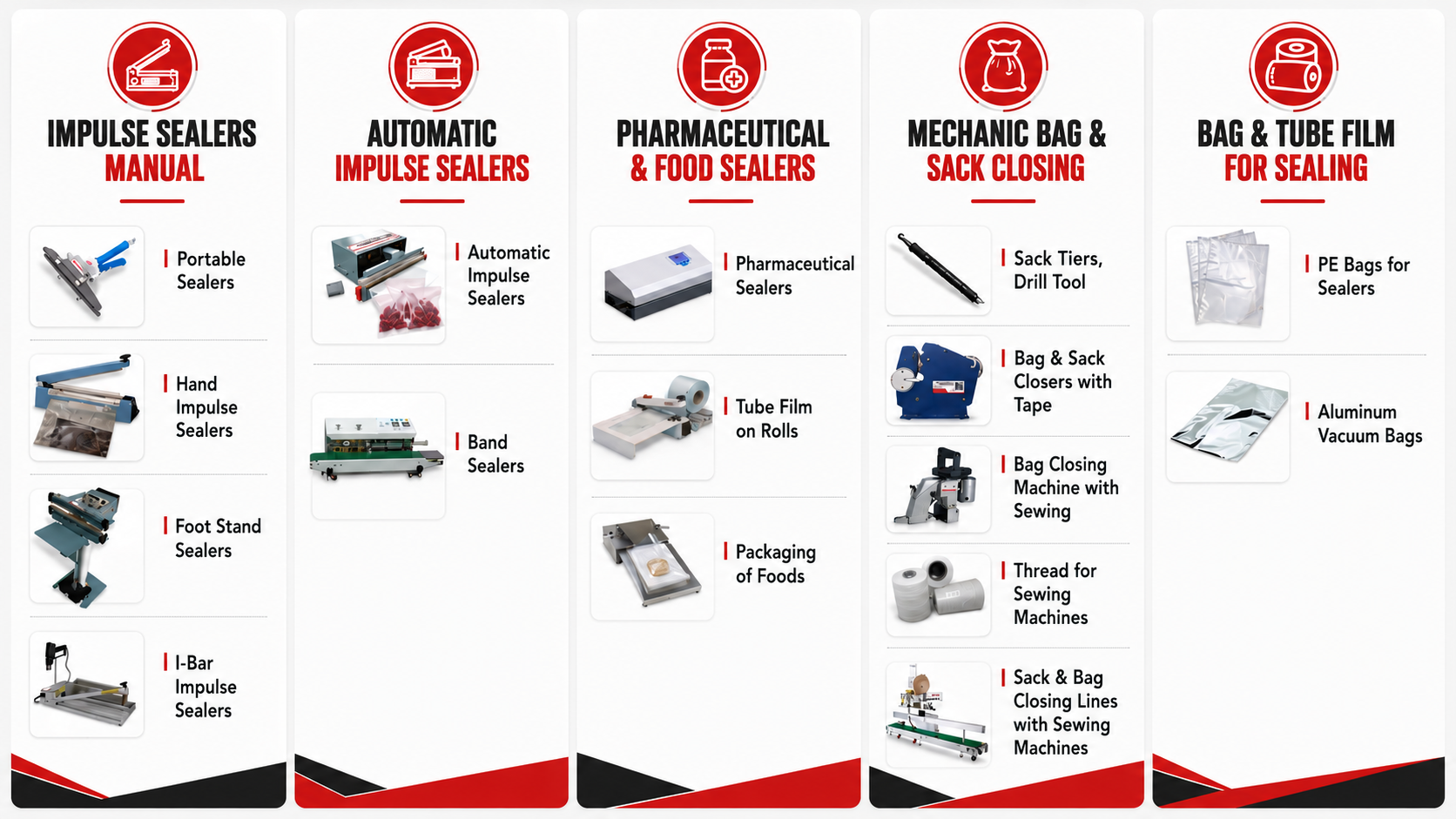
Hand Impulse Sealers, Bag Closers, Bag Sealers
The material is placed between the "jaws" and closed manually, then welded within the preset time interval.
- STEP-N00HI — sealing width 2mm, length N = 100, 200, 300, 400, 600, 800mm
- STEP-N05HI — sealing width 5mm, length N = 100, 200, 300, 400mm
- STEP-N02/05HC — same as above, with cutter knife function
- STEP-N02/05HCG — same as above, plus knife and hold solenoid function, with control for regulating welding and cooling time
Semi-Automatic Impulse Sealer, Bag Closers, Bag Sealers
The material is placed between the "jaws," which close semi-automatically, then welded within a preset time interval, followed by a set cooling time.
- STEP-NN0AI — sealing width 2mm, length NN = 350, 450, 600mm
- STEP-NN5AI — sealing width 5mm, length NN = 350, 450, 600mm
- STEP-NN5VA — vacuum, sealing width 5mm, NN = 450, 600mm
IP Bar Welder
The material is placed between the "jaws" and closed manually, then welded within the preset time interval, and finally the excess foil is cut.
- STEP-NN0IP — material sealed with a round wire, length NN = 450, 600, 800mm
Roll Sealing
The material is placed on a flat surface, and sealing is accomplished by scrolling the sealer over the desired seal seam. Sealing uses constant heat.
- STEP-80NHW — seal width:
- N = 1: 5mm width
- N = 2: 1mm width
- N = 3: 10mm width
Other types and variants
- Foot Operated Sealers
- Vertical Sealers
- Tape Sealers
- Vacuum Sealers
Spare parts
An important part that wears out on a bag welder is the Teflon protective foil. Teflon is used to protect the hot wire from the plastic, so no plastic particles transfer to the welding wire and burn into ash or slag. Teflon protection quality differs across machine types — check the included instructional manual for the correct structure. Sal-Tech Easy Packaging stocks a wide range of standard spare parts for bag welders, including spare parts for Mercier pulse welders, compatible with other types sold.
Related areas
Vertical Bag Machines.
Written by
Gunnar Salbæk
CEO / Industrial Design, 35 years of experience in the field.
Malaga, 17.12.2021