
Get the best out of the banding process — what it can and what it can't do.
Typical equipment for banding
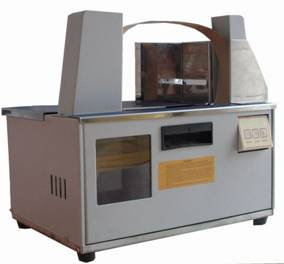
STEP Band 800
|
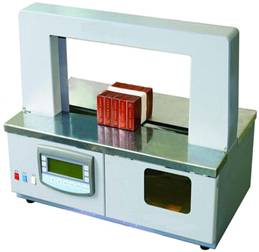
STEP Band 1000
|
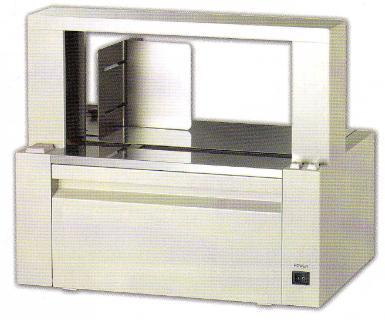
STEP Band 1100
|
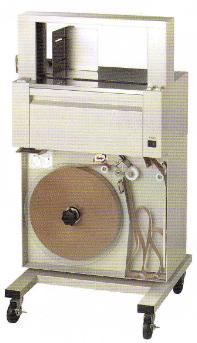
STEP Band 1200
|
Process
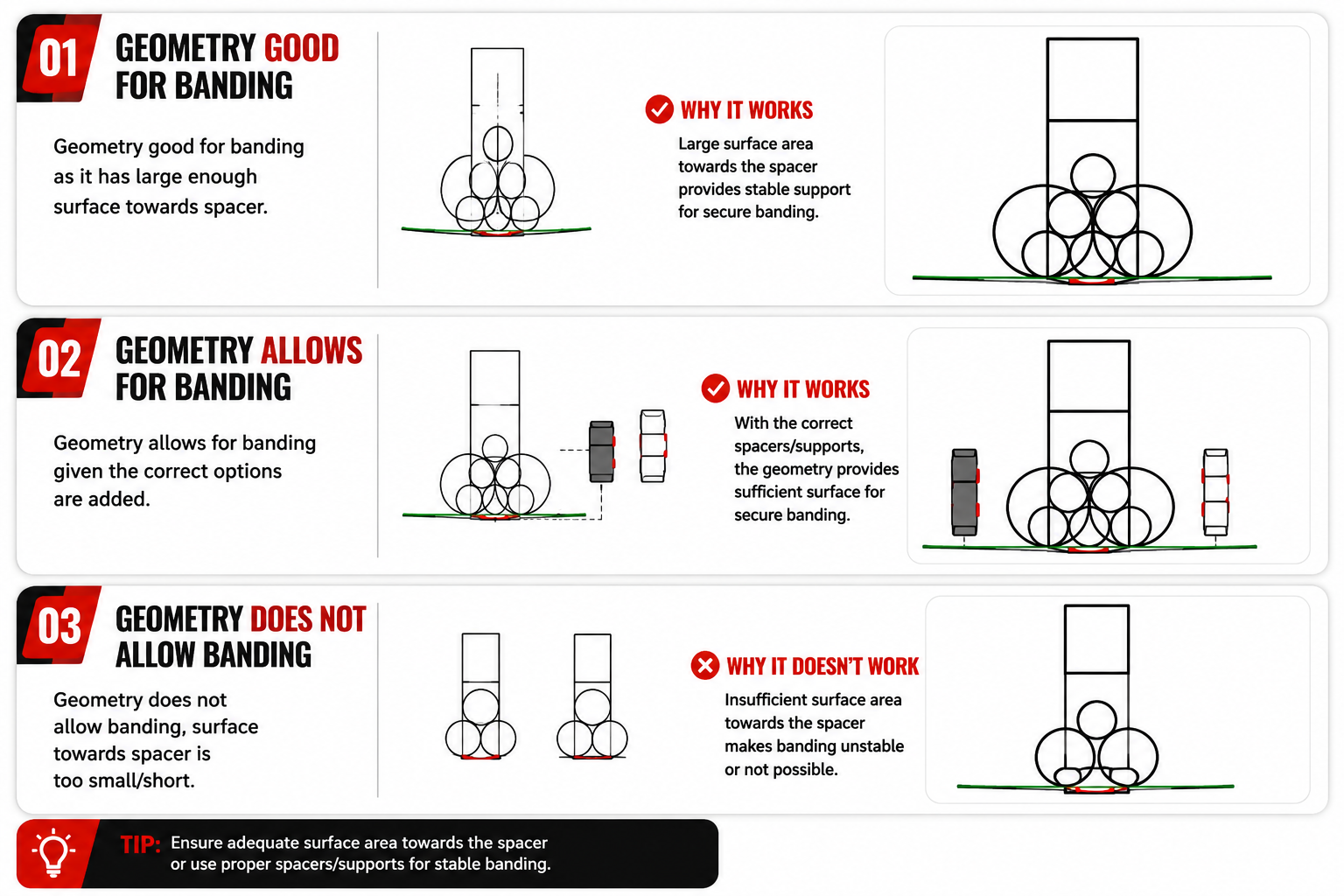
With the banding process, a paper or film tape is placed around the product. The tape is either heat-welded or ultrasonically welded, holding the product in place. Banding is done automatically or fully automatically only. Before banding, the product — whether a single unit or several items — must be in its final position, and that position must be geometrically stable. The product needs enough surface area against the banding spacer so the tape can release once tightened. Both hard and soft products can be banded within limits: the surface toward the spacer must be above 50mm and flat. Banding suits products with little strength, since tension can be set from zero up to about 18kg, depending on the machine.
Equipment types
Manual
Paper wrap closed with tape. No machine or equipment needed.
Semi-automatic
Support equipment only, in connection with production done individually.
Automatic
Ring banding is not possible as standard, but Sal-Tech Easy Packaging has solutions for this using open/closing arches. Product size is limited to arch size, and if the product needs to be turned inside the arch, by the arch diagonal.
Banding machines feed the tape automatically, in two main forms:
- The tape is pushed up in a loop, ready for banding — no product can be inside the machine while the tape is set. On start, the tape is pulled back for tension, then welded and cut. Tension ranges from a few grams up to about 18kg. Example: STEP Band 800.
- Banding machines that shoot the tape around the arch, then on start open the arch and pull the tape back around the product for tensioning and welding. Examples: STEP Band 1000, STEP Band 1100 or STEP Band 1200.
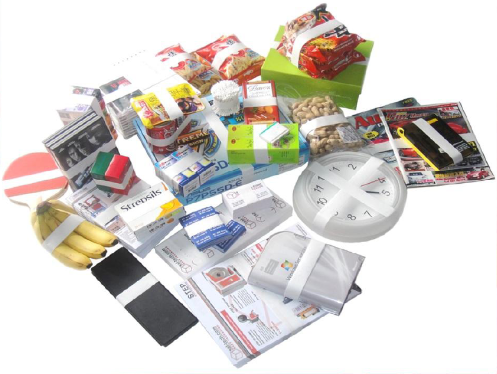
Typical products banded
Fully automatic
As with automatic equipment, ring banding is only possible using open/closing arches, and product size is limited to arch size and diagonal turning clearance.
|
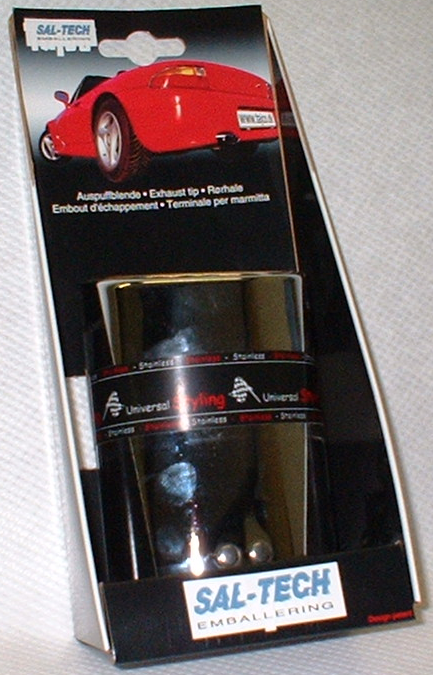
Case — Tajco solution Tailpipe fixed to a cardboard back cover using band tape, sewing the tailpipe to the board. Fully automatic, capacity up to 16–20 per minute. |
|
|
Case — Novo Nordisk Problem: an upright product on a Møller & Davids automatic line for packaging of insulin pens offered too little surface toward the spacer. Solution: a side-turned machine. |
|

|
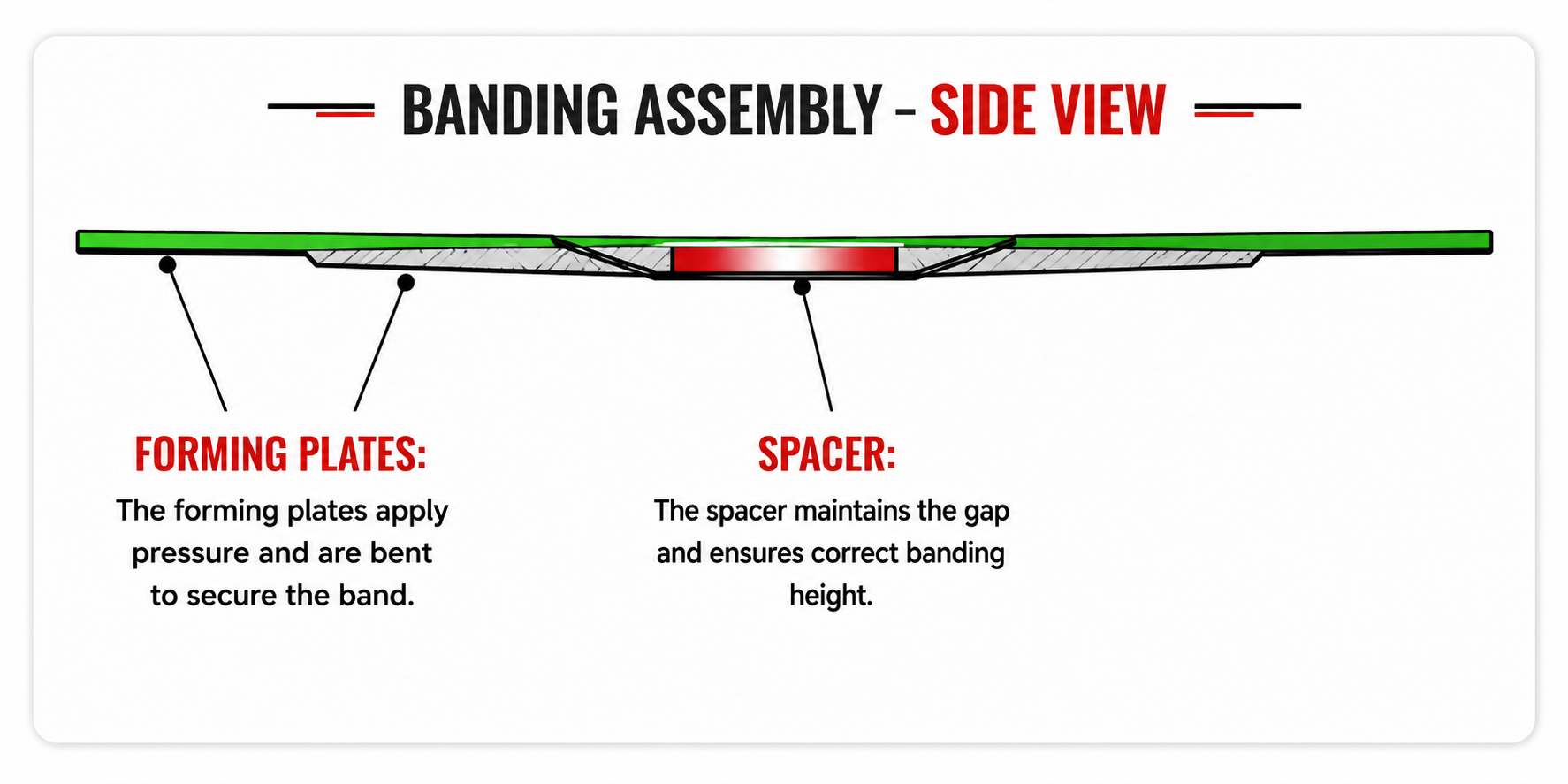
Case — Graphic product, 2-sheet A4 Problem: a graphic product of as little as two A4 sheets needed banding. Solution: tension against adjustable forming plates so the tape "breaks" around the edge and holds both sheets together. |
|
Project-specific and more advanced banding solutions can be developed per trade as project solutions.
Tape types
Paper tape
PW "Paper White" or PB "Paper Brown", 70, 80 or 90 g/m², with polypropylene coating on 1 or 2 sides, approx. 20 micron, widths 20, 30, 40, 50mm.
Film tape
- FTN — ultrasonic welding, polypropylene, 125–135 micron, milky-clear or colour, prints 1–8 colours, widths 15, 20, 30, 40, 50mm.
- PEHD — ultrasonic welding, low-density polyethylene, 80–85 micron, very clear, widths 15, 20, 30, 50mm.
- FTB — heat sealing, polypropylene, 90, 100, 110 micron, widths 20, 30, 40mm.
- FWG — ultrasonic welding, foamed polypropylene, 120, 170, 210 micron, white silver look, prints 1–8 colours, widths 15, 20, 30, 50mm.
Coil types
When ordering, it's important to know which machine the tape is for. Inside core diameter Ø40, Ø50 or Ø76; tape widths 15, 20, 29, 30, 40, 47, 50mm and more.
Environmental conditions
PP and LDPE materials are of special interest, as they are often heat-welded.
| COMPONENT | SHARE |
| PP or LDPE homopolymer | approx. 97% |
| Chalk | approx. 2–3% |
| Colour pigment (non-toxic) | approx. 1–2% |
Toxic and chemical reactions
Polypropylene and polyethylene are chemically and biologically inactive, and safe for contact with foodstuff.
Physical contact
No risk, except mechanical.
Welding of PP and LDPE
Keep the working area well ventilated at all times. Below 150°C, smoke and fumes are minimal and harmless. Both PP and LDPE can be ultrasonically welded without added ventilation, as fumes stay within the welding zone.
Fire risk
Polypropylene melts at approx. 165–170°C in air. Decomposition starts at 300°C, releasing low-molecule hydrocarbons. It self-ignites at 380°C.
Burning
Controlled burning is recommended. Once ignited, the material continues burning even if the ignition source is removed. Decomposition produces H₂O and CO₂; with low oxygen presence, it produces a toxic monoxide.
Reuse
PP and LDPE materials can be reused, similar to paper.
Related areas
Strapping — with strap that is welded or sealed with a seal.
String tying — using plastic, rubber or viscose to tie and hold the product.
Written by
Gunnar Salbæk
CEO / Industrial Design, 20 years of experience in the field.