
How do you get the best out of Pallet Wrapping? What it can and cannot do.
Typical equipment for pallet wrapping
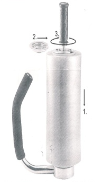
Manual Hand Film Dispenser
|
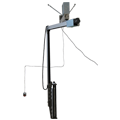
Semi-automatic E3 Wrap 2100
|
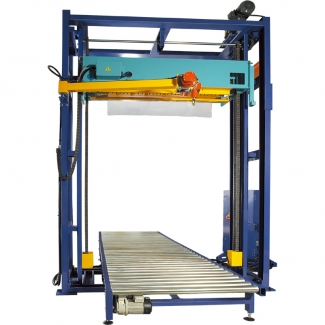
Automatic EXP-501
|
Fully Automatic EXP-702
|

Process
The development provides a film around one or more products with the aim to stabilise, protect and secure the cargo from tampering or theft. There are two main methods of the pallet wrapping process: the Vertical Development and the Horizontal Development. The highly stretchable film is wrapped around the item while adjusting the tension; the film provides secondary protection. Other products which can't resist the tension of the film can, in principle, be damaged. It is thus important that the product packaging is stabilized and maintained before and during the wrapping process.
Pre-treatment of the film by winding
- Brake pre-stretching directly from the roll — the core is slowed down while the product/pallet pulls the film from the roll.
- Brake pre-stretching using the roller system, then brake rollers while the product/pallet pulls the film through the rollers.
- Mechanically adjustable brake pre-stretch
- Magnetic / electric adjustable brake pre-stretch
- Motorized pre-stretching through the roller system — rollers regulate the product, filmed with minimal tension.
- Fixed pre-stretch degree
- Variable pre-stretch degree
- Pre-processed sheet, used in connection with the above processes.
- Fort solid film
- Perforated film
Concepts of pallet wrapping — vertical development
- Pallet wrapping basics: the pallet is wrapped to provide protection and stability of the product for day-to-day transportation — normal, clear film for general distribution.
- Pallet wrapping and storage: the pallet is wrapped for stability and protection of the product over time, including:
- Dust-proof pallet wrapping, top film used
- Waterproof pallet wrapping, top film used
- UV light protection for the product
- Black film for theft/tamper-proofing "expensive" products
- Film with special properties, such as anti-rust
- Sealing of the product
- Other variables in the wrapping process — number of top and bottom turns (governed by time or by count; count is the best solution), and the cycle:
- Bottom – top – bottom
- Bottom, high speed to the top – bottom
- Top – bottom
- Bottom – mid position – top – bottom
- Bottom – top – level down under top film – pause – top – bottom
- Single level
Applicable equipment in relation to different processes
Manual
Physical dimensions such as height and weight define the handling limitations of manual hand wrapping.
- Hand film dispenser for hand film, 450 or 500mm width.
- Hand film handles for mini rollers, 100 to 125mm width.
- Hand-preferred films for direct winding without a secondary tool.
Semi-automatic
Physical dimensions such as height, diameter and weight put restrictions on what a machine can perform. Each machine series typically offers options that enable greater dimension, weight and diameter — this applies to semi-automatic, automatic and fully automatic machines alike.
Basic machine concepts:
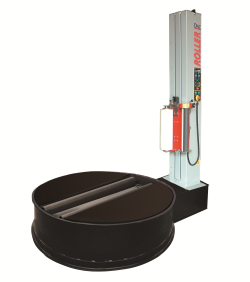
- Tower type with turntable — the pallet rotates while being wrapped.
- Satellite type — the film wraps around a stationary pallet.
- Tower type turntable with horizontal rolls — the product is rolled and rotated.
- Combining turntable and satellite aggregates leads to extreme process speeds.
- Semi Automatic Pallet Wrapping EXP-408 — manually attach the film to the pallet before the process starts; the machine automatically cuts the film once complete. Basic solution.
- Semi Automatic Pallet Wrapping EXP-108 — manually attach the film to the pallet before the process starts; the machine itself cuts the film once complete. Advanced solution.
- Best used with a manual process where the wrapper has a pause function.
Automatic
- Automatic Pallet Wrapper EXP-501 — starts the process automatically and holds the film after cutting, ready for the next pallet. The only manual work is loading/unloading the pallet, handled by truck or pallet truck.
- Best used with a manual or automated integrated solution: the STEP HB 800.
Fully automatic
- Fully Automatic Pallet Wrapping EXP-202A — the machine develops and manages the pallet without human intervention. The pallet is transported onto the taxiways, wrapped and carried out. It is important that the pallet has the necessary stability for internal transport.
- Top films for fully automatic, integrated solutions.
Other equipment integrated around the wrapping process
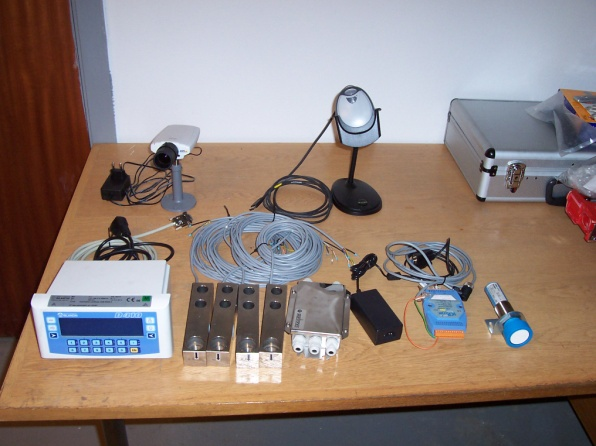
- Weighing of the pallet with an integrated weight system.
- Data collection around the packed pallet, stored to the ERP system using the STEP Data Exchange System — scanning the pallet registration number, weighing, dimension measurements, image capture, and 360° video capture.
- Top film dispenser.
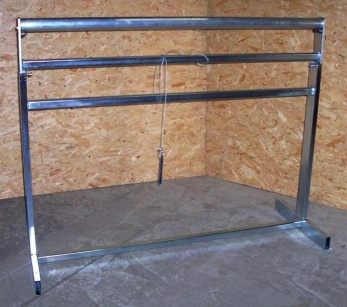
- Top plate for stabilisation of the pallet during wrapping.
- Taxiways on the turntable and/or outlets for manual or automatic pallet change.
- Label marking of the pallet.
Typical process rates
Depending on machine type/process, pallet dimensions, product, film selection, etc.
| TYPE | RATE |
| Manual | 5–10 pallets/day. A person can wrap more, but this is not recommended as a permanent solution due to the negative impact on the working environment. |
| Semi-automatic | 5–100 pallets/day |
| Automatic | 5–30 pallets/hour |
| Fully automatic | 5–45 pallets/hour |
Fully automatic pallet wrapping, projected full-optimal solutions, up to 70–100 pallets per hour. Advanced wrapping and packaging lines incorporate many process types in project-specified solution concepts and lines. In many cases, several technologies are combined to ensure optimal use of each element, minimising material and energy consumption. Data are collected and processed to ensure the right quality and information.
Other types of machines and equipment for wrapping
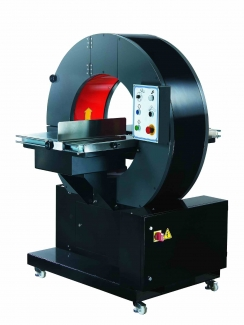
Horizontal Wrapping EXR-401
|
Roll Wrapping
|
STEP Data Exchange System
|
Top Films Dispenser STEP TF 1500
|
Film types
It is expensive to use an inexpensive film.
It is extremely important that the correct film is used for the right purpose, so make sure you get a price-optimal solution for your product. This choice starts by selecting the machine, aggregate type, and process point in relation to your production flow, material selection, and secondary processes that affect the entire packaging process — including stability while moving internally from the process point onward.
Hand film
- LDPE cast or blown; clear, white, black, other colours. Additional features: UV, rust protection.
- Thickness: 9 to 35 microns.
- Width: 450–500mm on core ø50–ø76 (core-movable type). Hand scrolls 75–150mm on core ø76.
- Pre-stretch: regular or pre-stretched.
Machine film
- LDPE cast or blown; clear, white, black, other colours. Additional features: UV resistant, rust protection, perforated holes, added glue, etc.
-
- Butene/Hexene types — short chains, LDPE low density, limited strength and elongation. STEP Basic Stretch.
- Octene types — long, branched chains, LLDPE linear low density, good general strength and elongation. STEP Advanced Stretch.
- Metallocene types — numerous, widely branched chains via metallocene catalyst. Especially good strength, tear and elongation properties. STEP Ultimate Stretch.
- Thickness: 9 to 35 microns.
- Width: 500mm on ø76mm core, outer diameter up to 250mm (common European sizing). Jumbo rolls: 750mm width, outer diameter up to ø450mm.
- Pre-stretch degree: 100% to 400%, pre-stretched. Typical commercial products in Denmark are 150%, 280% and 300% pre-stretch.
- Interior or exterior glue.
- Invoiced gross-to-net by DKK/kg or DKK/roll, with meters and thickness specified.
- Roll packing: machine film wraps on pallets typically 2 or 3 layers upright — rolls should not lie flat, for balance and storage stability. Each layer is typically packed 15 per EURO pallet (no overhang) or 22 with overhang. Other variants exist.
Environmental conditions
PE material composition is of particular interest, as it is often heat-welded.
| COMPONENT | SHARE |
| Polyethylene | approx. 98% |
| Colour pigments (non-toxic) | approx. 1–2% |
Toxic and reaction properties
Polyethylene is chemically and biologically inert, and can be used directly for food.
Physical contact
No risk, beyond the mechanical.
Welding, gluing and printing of PE materials
Keep the workplace ventilated to avoid exposure to welding fumes. Below 150°C, smoke and steam generation is insignificant — always provide adequate ventilation for worker welfare. PE can be friction- or ultrasonically welded without added suction, as fumes stay within the weld zone. PE has low surface tension, so it can only be glued or printed after surface treatment.
Flammability
Polyethylene melts at approx. 109–125°C.
Burning
Controlled burning is recommended. Once ignited, the material continues burning even after the ignition source is removed. Decomposition produces H₂O and CO₂; with low oxygen presence, it also produces a toxic monoxide.
Recycling
PE materials are suitable for recycling.
Written by
Gunnar Salbæk
CEO / Industrial Design, 30 years of experience in the field.