
Get the best out of the string tying process — what it can and what it can't do.
Typical equipment for string tying
Felins Pak Tyer 2000-6" Automatic
|
Felins Coil Tyer 2000-6" Automatic
|
Felins ATS Fully automatic
|
Felins Rotary Tyer Automatic
|
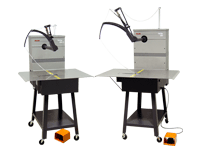
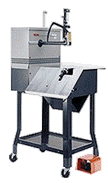
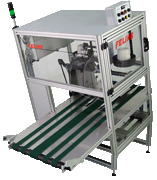
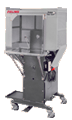
Process
The process starts as the product passes through the machine, where the string is tightened around it. The string is then inserted past the tying point, the head node attaches, and the string is cut — a new string is ready for the next product straight after. String tying materials include LDPE, PET, cotton, elastomer, and elastic, in forms like poly tape, twisted poly, and spiral twist. Hard products are bound with elastic cords; soft products are bound with fixed strings.
String tying has only a few restrictions, since it doesn't directly affect the product itself. When the cord is tensioned, the product needs enough hardness to resist the pull of the string while still holding sufficient tension around it as a bundle. Minimum bundle length typically runs down to 20–25mm, sometimes less. The outer limit is set by the height of the arm that ties the loop.
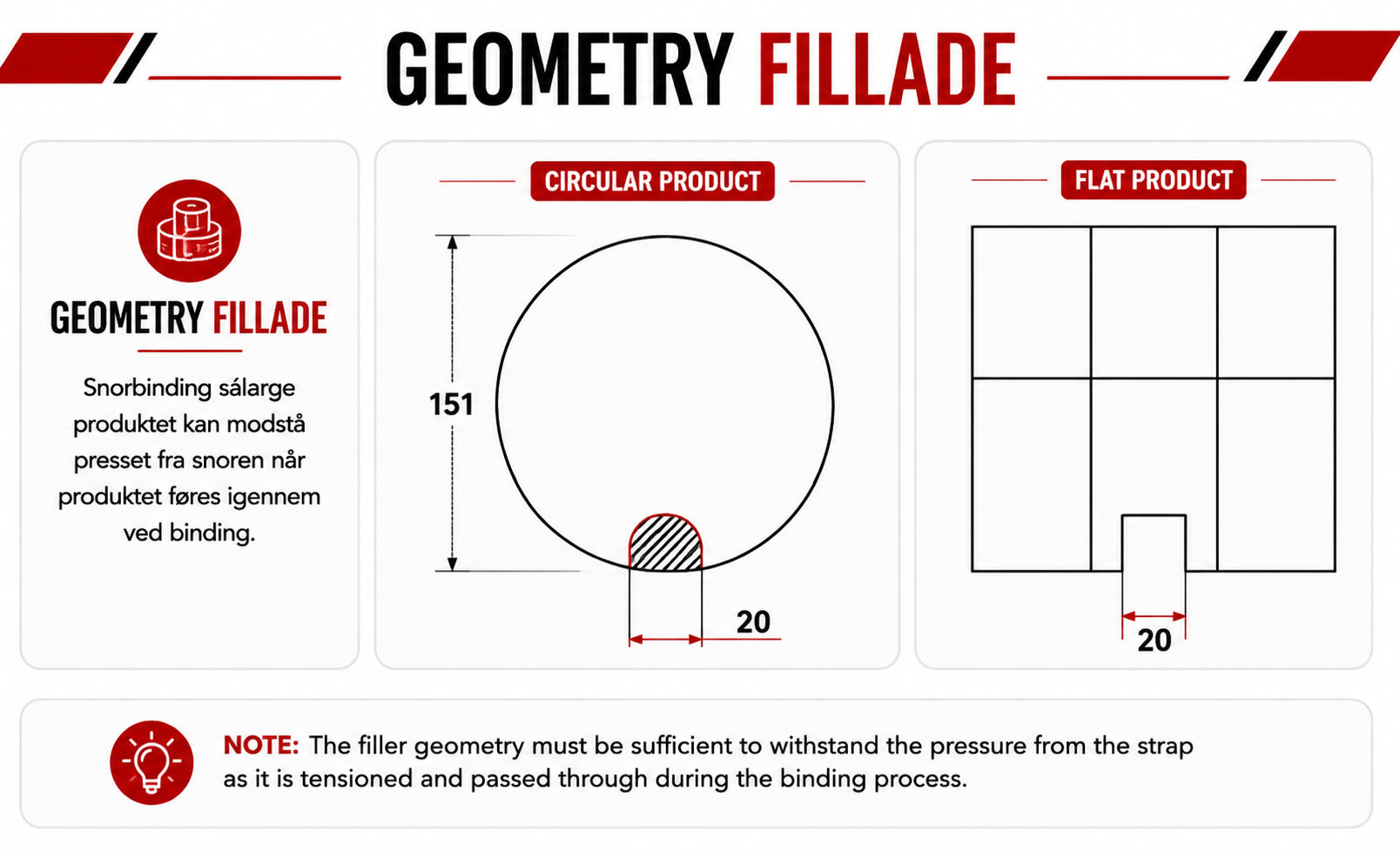
Equipment types
Manual
Manual binding has been around since the first jungle rope — no machinery or equipment needed.
Semi-automatic
No equipment exists for semi-automatic string tying.
Automatic
Requires an operator, in two main forms:
- Rotary Tyers — the string is placed around the product and attached to the underside via a rotary mechanism. Common in the graphics industry, laundries, and similar.
- Linked arm binders — the string passes behind the product after being fed into another string; the head attaches and the cord is cut. Example machines: Pak Resort 2000, Coil Resort. Common in laundries, horticulture, and cable manufacturing (coil). Left/right and tandem variants also exist.
Typical products tied with string
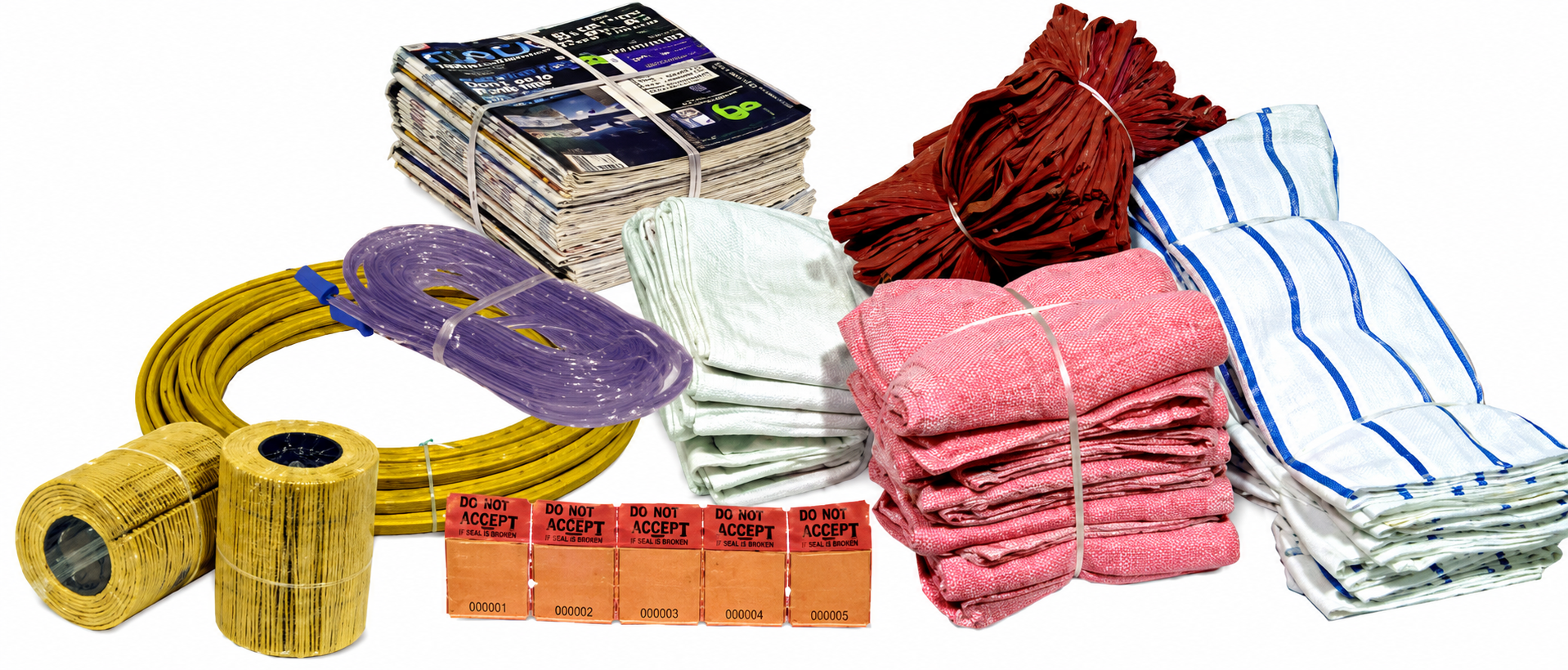
|
Fully automatic Used across laundry, horticulture, and industry. A range of fully automated solutions load the product facing the conveyor, or onto the open belt, and the machine ties it from there. |
|
Project-specific and more advanced string tying equipment, and industry-specific processes, can be built on request.
Decommissioning
|
Cord/string typically comes on a core of Ø76 without the core, or Ø40–50 with a cardboard core, in a plastic wrapper — often customised per machine type. When ordering, the string layup and machine type matter — know the string to be used, meters per rewind, termination method, and whether it's geometrically locked or taped. See Elastic String. |
 |
Related areas
Banding — using a plastic band that is welded.
Wrapping — with ribbon, using plastic or paper "band" that is welded.
Written by
Gunnar Salbæk
CEO / Industrial Design, 20 years of experience in the field.