
How to get the most out of strapping. What it can and cannot do.
Typical equipment for strapping
STEP H-46 Kronos Tensioner & sealer, battery driven
|
STEP H-45L Helios Battery driven hand strapping tool
|
STEP TP-202CE1 Semi-automatic packing table, heat welding
|
STEP TP-6000CE1 Automatic arch machine, 850×600mm, 12mm PP strap
|
STEP TP-601A Fully automatic arch machine, roller conveyor feed
|


|
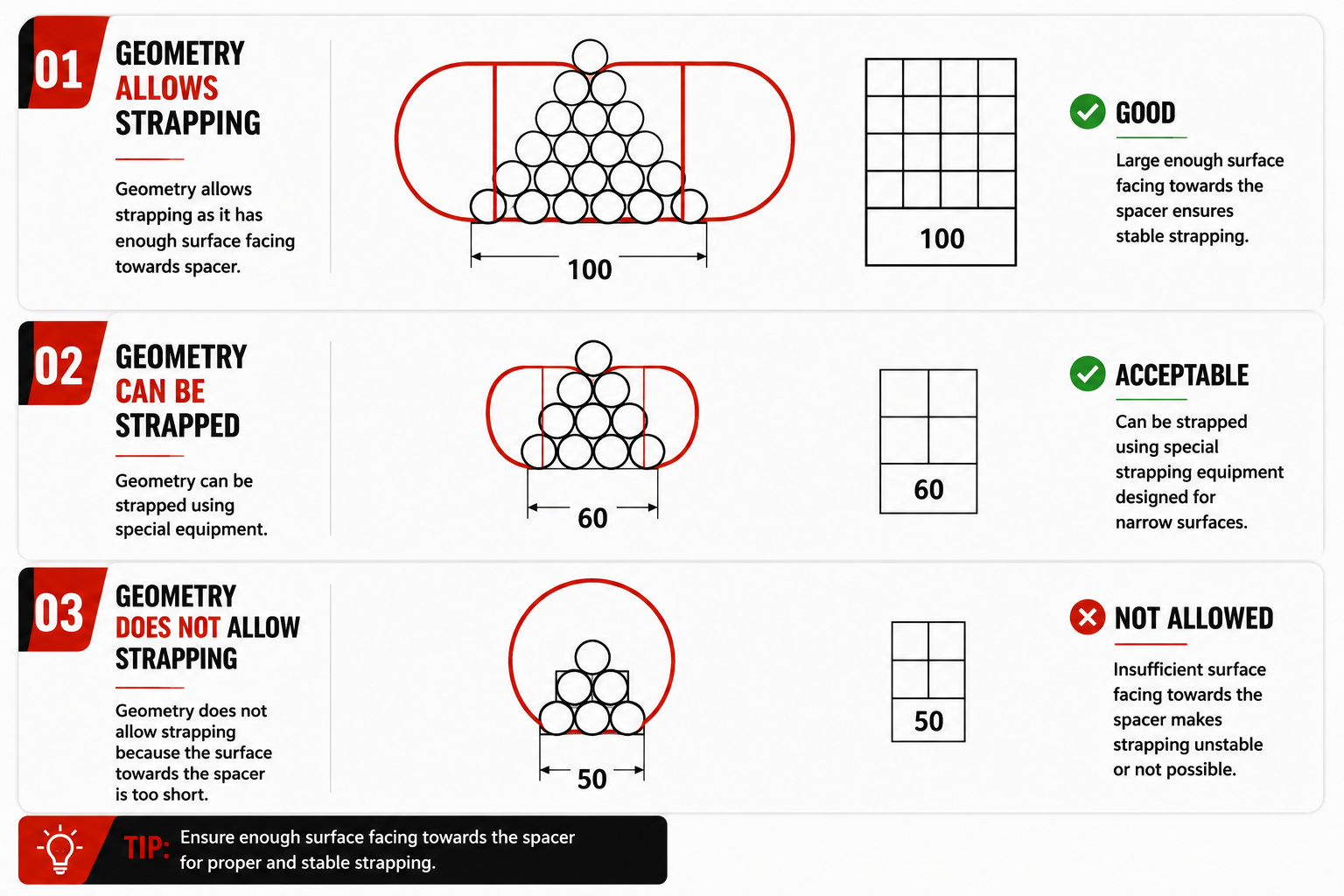
Process With strapping, a strap is placed around the product. This strap is either welded, closed with a seal, or geometrically locked, so that it holds firmly around the product. Strapping equipment ranges from manual, semi-automatic, automatic to fully automatic. Before strapping, the product — whether a single unit or several items — must be positioned, and its final position must be in place before strapping is carried out. This position must be geometrically stable. (See the article on geometrical stability in packaging.) To perform correct strapping, the product must be positioned so that it has sufficient contact surface, ensuring that strap retraction versus deflection height allows the strap to remain tensioned after the process. Both hard and soft products can be strapped, but with limitations for both types. The general limitation is that the contact surface must typically be larger than 100mm and flat. |
 |
Equipment used for different strapping processes
Manual
General: Battery-driven strapping tools with flexible settings, a wide tension range, and the ability to accommodate both PP and PET straps.
STEP Kronos H-46A is suitable for light and universal applications, while STEP Kronos H-46B is suitable for heavy industry applications — both products are practical for iron, textile, foodstuff, merchandise and other related products for strapping.
STEP H-45L battery-driven hand strapping tool is part of the STEP H series of manual hand strapping tools. It is independent of a wired power supply, making it ultra-portable. With friction-weld sealing technology, it is also independent of third-party seals.
Semi-automatic
General: Ring strapping is possible. There is no upper package size limit beyond what can be handled on the packing area.
Semi-automatic packing table TP-202 — the PP strap is manually guided around the product, then tensioned and heat-welded. Product positioning is done manually against the stationary machine.
Semi-automatic pallet strapper TP-202MV — the PP/PET strap is manually guided around the pallet, then tensioned and welded with heat or friction. Typically, the machine is positioned relative to the product, which stands on the floor.
Automatic
General: Ring strapping is not possible as standard, but Sal-Tech Easy Packaging offers solutions using open/closing arches. Package size is limited by arch dimensions and the product's diagonal, if it needs to be turned 90 degrees inside the arch.
Automatic arch machine TP-601D — the strap is manually guided around the product, then tensioned and heat-welded. Product positioning is done manually against the stationary machine.
Fully automatic
General: Ring strapping is not possible as standard, but Sal-Tech Easy Packaging offers solutions using open/closing arches. Package size is limited by arch dimensions and the product's diagonal, if it needs to be turned 90 degrees inside the arch.
Automatic arch machine TP-601A — the machine feeds the strap around itself, and on start pulls the strap out of the arch and tensions it around the product. The strap will be heat-, friction-, or ultrasonically welded. Product positioning is fully automatic, via roller conveyors (TP-601A), belt conveyors (TP-601B), push-in systems, corner pushers, or overhead feed with drop and subsequent push-out — this type of solution is typically project-tailored.
Project-specified and more advanced, industry-related strapping equipment
Graphic industry STEP TP-702NS Fully automatic print media strapping machine
|
Corrugated industry STEP TP-702CQ Corrugated strapper, 4-side squaring function
|
Graphic industry · Newspapers STEP TP-702NIL Fully automatic for in-line cross strapping
|
Distribution · Boxes TP-601B × 2 units Corner pusher strapping, project solution
|


 |
STEP Ergo Strap TableYou can also find a combined system focused on ergonomics and time-saving. STEP Ergo Strap Table with built-in scale and adjustable height The STEP/E3 Hallbrook Ergo Strap Table is an ergonomic design used for weighing and strapping boxes and other products that require tensioning. It is innovatively engineered to give the operator comfort with an adjustable table height and a built-in scale, delivering a more efficient process for weighing and packing. |
Strap types
|
Plastic strap
|
Steel strap
|
Woven strap
|
Delivery form: When ordering strapping tape, it's important to know how it fits your equipment. Strap is typically delivered on an inside core diameter of Ø60, Ø76, Ø150, Ø200, Ø230, Ø280 or Ø406, in a number of standard widths, typically 110, 150 or 190mm. Steel strap is delivered in single coils or oscillating spools. Strap widths produced range from 4mm to 38mm, and even wider for woven strap types.
Choose the right strap for the job
|
PET The stiff strap suitable for replacing steel strap, as it feeds easily through openings and has high tensile strength. |
PA Hygroscopic strap, which can work with products that expand when they become wet, such as timber. |
WG High tensile strength and very flexible around corners — able to move with the product. |
PP Suitable for standalone machines in close contact with the operator — easier to apply and low-cost. |
Stainless steel Stainless steel strap, when the application requires it. |
Environmental conditions
PP material composition, of special interest as it is often heat-welded
- Polypropylene homopolymer, approx. 97%
- Chalk, approx. 2–3%
- Colour pigment (non-toxic), approx. 1–2%
Toxic and reaction properties
Polypropylene and polyester are chemically and biologically inactive, and can be used directly in contact with foodstuffs.
Welding of PP material
It is recommended by the Labour Inspectorate that welding fumes from plastic welding be vented outdoors wherever possible. When welding below 150°C, smoke and vapour development are considered minimal and harmless. It is nevertheless always recommended to provide adequate ventilation for general worker wellbeing.
It is not recommended to heat-weld PET (polyester) without proper extraction — and only for automatic equipment where operating personnel are not positioned close to the weld zone.
Both PP and PET can be friction- and ultrasonically welded without requiring established extraction, as all welding fumes remain within the weld zone.
Flammability
When polypropylene is heated in air, the material will melt at approx. 165–170°C, and decomposition begins at around 300°C, releasing low-molecule hydrocarbons. Self-ignition occurs at 380°C.
Burning
Controlled burning is recommended. Once ignited, the material will continue to burn even after the ignition source is removed. Decomposition products from burning are H₂O and CO₂. If burned with a low presence of oxygen, combustion will also produce a monoxide, which is toxic.
Physical contact
No risk, beyond the mechanical.
Reuse
According to German law, PP packaging material must be black. We recommend using this colour wherever possible, and marking it appropriately otherwise.
For PET, the colour must be green. PET is particularly well-suited for reuse.
Author of the Article
Gunnar Salbæk
CEO / Industrial Design with more than 30 years of experience in the field.